
Government Budget 2026-27 Pakistan - Complete Guide
📌 In This Article▼
- Key Budget Numbers (June 12, 2026 Announcement)
- For Salaried People: The Good News
- Salary Increase (10%)
- Income Tax Relief
- What Didn't Change
- For Businesses: Mixed Messages
- Tax Cuts for Small Traders
- Super Tax Changes
- Corporate Income Tax Unchanged
- Import Duty Reductions
- For Consumers: Prices Going Up & Down
- Product Prices That May Drop
- Products That Will Get Expensive
- Key Spending Allocations (Development Budget)
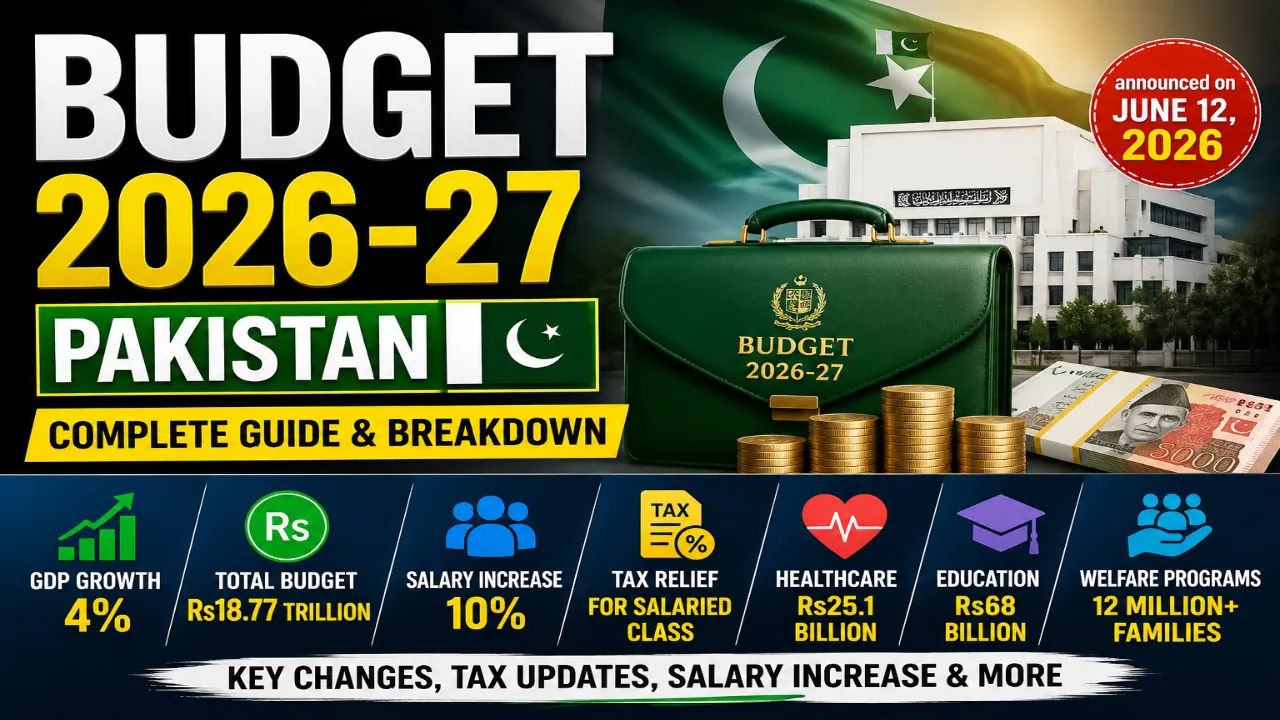
- Healthcare: Rs25.1 Billion
- Education & Higher Education: Rs68 Billion
- Flood Relief & Climate Projects: Rs103.1 Billion
- Welfare Programs
- Tax Changes That Affect Everyone
- Overseas Pakistanis Get Relief
- Youth Development Focus
- IT Sector Gets Extension
- Economic Targets Explained
- GDP Growth Target: 4%
- Inflation Target: 8.2%
- Budget Deficit: 3.6% of GDP
- Primary Surplus: 2% of GDP
- Revenue: Where Government Gets Money
- FBR Tax Revenue: Rs15.26 Trillion
- Non-Tax Revenue: Rs5.34 Trillion
- International Borrowing
- National Artificial Intelligence Initiative
- Provincial Transfers: Rs7.4 Trillion
- FAQ: Government Budget 2026-27
- What This Budget Really Means
- The Good
- The Challenges
- Bottom Line
- Important Dates
- Final Thoughts
On June 12, 2026, Finance Minister Muhammad Aurangzeb presented Pakistan's federal government budget for fiscal year 2026-27.
Total outlay: Rs18.77 trillion.
This is more than just a number. This budget affects your salary, your taxes, your business, your family's welfare programs. Everything.
Here's what actually changed and what it means for you.
Key Budget Numbers (June 12, 2026 Announcement)
| Metric | Amount | Details |
|---|---|---|
| Total Budget Outlay | Rs18.77 trillion | 7% increase from previous year |
| GDP Growth Target | 4% | Government's expected economic growth |
| Inflation Target | 8.2% | Expected average inflation |
| Budget Deficit | 3.6% of GDP | Deficit as percentage of GDP |
| FBR Tax Revenue Target | Rs15.26 trillion | Collected by Federal Board of Revenue |
| Non-Tax Revenue | Rs5.34 trillion | Other government income sources |
| Provincial Transfers | Rs7.4 trillion | Money sent to provinces |
| Development Programme (ADP) | Rs3.67 trillion | National development outlay |
| Debt-to-GDP Ratio | 68.5% | Country's debt level |
| Policy Rate | 11.5% | Down from 22% previously |
For Salaried People: The Good News
Salary Increase (10%)
The budget announced a 10% increase in salaries for government employees. This is significant.
For a government servant earning Rs50,000/month, this means Rs5,000 extra. For Rs100,000/month, that's Rs10,000 extra.
The increase applies across all government employee grades.
Income Tax Relief
The government announced tax relief for the salaried class.
Specifically:
- People earning between Rs1.2 million and Rs2.2 million annually may see reduced tax rates
- Lower withholding taxes on transactions
- Advance income tax on exports reduced from 2% to 1.25%
What Didn't Change
The income tax threshold remained at Rs50,000/month. So while relief is offered, the basic threshold didn't move.
Real impact: Salaried people get some breathing room, but it's not a revolution.

For Businesses: Mixed Messages
Tax Cuts for Small Traders
The government introduced the Fixed Tax Asaan Scheme.
Retailers earning up to Rs200 million annually can now pay a fixed 1% tax on sales instead of percentage-based calculations.
This is supposed to simplify taxes for small business owners.
Super Tax Changes
The Super Tax on high earners was partially abolished:
- Income from Rs15-50 crore: Super tax abolished (was 1-7%)
- Income above Rs50 crore: Reduced to 8% (from 10%)
This helps wealthy business owners but doesn't affect average people.
Corporate Income Tax Unchanged
Corporate Income Tax rates stayed the same. No surprise here—the government didn't want to disturb larger corporations.
Import Duty Reductions
Specific sectors got relief:
- Raw materials for medicine: Customs duty abolished (helps medicine prices drop)
- Auto parts for local manufacturing: Reduced from 20% to 10%
- Raw materials for manufacturing: May be reduced to 1%
Real meaning: Government is pushing "Make in Pakistan" through tax incentives.
For Consumers: Prices Going Up & Down
Product Prices That May Drop
Some consumer products face tax adjustments that may lower prices:
- Cosmetics
- Face powder
- Mascara
- Shampoo
- Soap
- Medicines (customs duty removed on cancer drugs and critical medications)
Products That Will Get Expensive
Electric vehicles, hybrid vehicles, and plug-in hybrids are expected to become more expensive due to increased import duties.
The government expects to generate Rs25.8 billion from Environmental Levy on vehicles above 2000cc engine capacity.
Real meaning: If you were thinking of buying an EV, prices just went up.
 Key Spending Allocations (Development Budget)
Healthcare: Rs25.1 Billion
Allocated for:
- Tertiary healthcare facilities
- Critical care centers
- Health infrastructure improvement
This is health spending under the Annual Development Programme (ADP).
Education & Higher Education: Rs68 Billion
Breaking down as:
- Rs46 billion for higher education and research (up from Rs34.9 billion last year)
- Rs22 billion for Daanish Schools (special education)
- Scholarships and student support programs
Flood Relief & Climate Projects: Rs103.1 Billion
For 43 hydroelectric projects, including:
- Rs14 billion for Diamer Bhasha Dam
- Rs10 billion for K-IV project in Karachi
- Climate resilience initiatives
Last year's floods cost Pakistan Rs822 billion. This allocation is the government's response.
Welfare Programs
Benazir Kafalat Programme will cover 12 million families (direct cash transfers).
Benazir Taleemi Wazaif will benefit 9.2 million children (education stipends).
These programs directly support poor families.
Tax Changes That Affect Everyone
Overseas Pakistanis Get Relief
Major announcements for people sending money from abroad:
- Lower withholding tax on remittances
- Reduced property levies
- Capital value tax on property scrapped
This matters because Pakistanis abroad send billions in remittances annually.
Youth Development Focus
68% of Pakistan's population is under 30. The government allocated:
- NAVTTC training for technical skills
- 515,000 young people trained (53% employment success rate)
- Higher education scholarships
IT Sector Gets Extension
Income tax exemption for IT sector extended until June 2029.
This helps Pakistan's growing technology industry attract investment and talent.

Economic Targets Explained
GDP Growth Target: 4%
The government expects 4% economic growth. Last year's actual growth was 3.7%, which fell short of the 4.2% target.
This is moderate growth—not explosive, but steady.
Inflation Target: 8.2%
Expected average inflation is 8.2%. This is important because:
- Lower inflation = your money buys more
- Current inflation has been high
- If achieved, 8.2% is improvement
However, inflation remains high by global standards.
Budget Deficit: 3.6% of GDP
The budget deficit (spending more than you earn) is targeted at 3.6% of GDP.
This is better than previous years and shows fiscal discipline.
Primary Surplus: 2% of GDP
A primary surplus means government is collecting more than it spends (excluding debt payments).
This signals economic recovery direction.
Revenue: Where Government Gets Money
FBR Tax Revenue: Rs15.26 Trillion
The Federal Board of Revenue targets Rs15.26 trillion in tax collection—an 8% increase from the previous year.
Government says FBR collections have grown from Rs7.2 trillion (three years ago) to Rs13 trillion (now).
This comes from better enforcement and expanding the tax base.
Non-Tax Revenue: Rs5.34 Trillion
Government also earns from:
- Utility profits
- Royalties
- Service fees
- Investment returns
International Borrowing
Pakistan returned to international capital markets:
- Raised $750 million through Eurobonds
- Entered Chinese capital market for the first time (Panda Bond)
- Strong investor demand
Meaning: International investors believe Pakistan is stable enough to lend money.
National Artificial Intelligence Initiative
The budget listed a National Artificial Intelligence Ecosystem Development Programme as a flagship $1 billion initiative.
This signals government recognition that AI is critical to Pakistan's future.
Specific details were limited in the announcement, but it shows priority on technology sector development.
Provincial Transfers: Rs7.4 Trillion
The federal government will transfer Rs7.4 trillion to provinces for their own spending.
This money goes to provincial governments (Punjab, Sindh, KPK, Balochistan) for:
- Healthcare
- Education
- Infrastructure
- Local development
FAQ: Government Budget 2026-27
Q: When does this budget take effect?
A: The budget was announced June 12, 2026, and takes effect July 1, 2026 (start of fiscal year).
Q: Will my salary increase?
A: If you're a government employee, yes—10% increase. Private sector salaries depend on individual employers.
Q: Will taxes go up?
A: Mixed. Some relief for salaried people and small businesses. Super tax reduced for high earners. Most people see slight relief.
Q: Will prices go down?
A: Some products (cosmetics, medicines, shampoo) may drop. EVs and high-engine vehicles will increase. Food prices depend on other factors.
Q: What's the inflation impact?
A: Government targets 8.2% inflation. If achieved, it's better than recent years but still high.
Q: Does this help the poor?
A: Yes. Benazir programs expanded (12 million families, 9.2 million children). Direct cash transfers and education stipends increased.
Q: What about overseas Pakistanis?
A: Major relief—lower remittance taxes, reduced property levies, scrapped capital value tax.
Q: Is Pakistan's economy improving?
A: Government claims recovery. Policy rate down from 22% to 11.5%. Debt ratio stable at 68.5%. But recovery is fragile.
Q: What's the biggest spending?
A: Debt servicing (interest payments). Then salaries. Then development projects. Most budget goes to existing obligations, not new projects.
Q: Will GDP really grow 4%?
A: Depends on global conditions. Last year target was 4.2%, actual was 3.7%. Government is generally optimistic but targets often miss.
What This Budget Really Means
The Good
✓ Salary relief for government employees ✓ Tax relief for salaried people ✓ Support for poor families (expanded Benazir programs) ✓ Investment in education and healthcare ✓ Stabilizing interest rates (policy rate down significantly) ✓ Support for small traders (Fixed Tax Asaan)
The Challenges
✗ Inflation still high (8.2% target) ✗ Limited new development spending (most budget goes to debt servicing) ✗ EV prices increasing (counterproductive for climate goals) ✗ Youth unemployment remains concern ✗ Provincial inequalities persist ✗ Fragile recovery (depends on stable conditions)
Bottom Line
This is a stabilization budget, not a growth budget.
Government prioritized fiscal discipline and supporting vulnerable people rather than explosive economic stimulus.
For most people: modest relief, continued financial pressure, but gradual improvement ahead.
Important Dates
| Date | Event |
|---|---|
| June 12, 2026 | Budget announced in National Assembly |
| June 30, 2026 | End of fiscal year 2025-26 |
| July 1, 2026 | Budget takes effect (FY2026-27 starts) |
| Throughout FY27 | New salary scales, tax rates, prices implemented |
Final Thoughts
Pakistan's budget is never just about numbers. It reflects government priorities, economic reality, and hopes for the future.
This budget prioritizes stability over growth, supporting vulnerable populations while maintaining fiscal discipline.
Whether it actually achieves the 4% growth target remains to be seen. Global conditions, monsoon rains, international relations—all affect outcomes.
But one thing is clear: the government is betting on gradual recovery, not rapid transformation.
For you and your family, that means modest relief now, hope for better conditions ahead, and continued financial attention needed.
Is the Facebook or Insta Server Down Today? What You Need to Know About the Meta Outage
June 12, 2026
Easypaisa Services Unavailable in Pakistan: Why the App is Down and What You Can Do
June 12, 2026
YouTube Automation 2026: Complete Guide to Start a Faceless Channel & Earn $500/Month
April 19, 2026
💬 Comments
No approved comments yet. Be the first to share your thoughts!
Leave a Comment
Your email address will not be published. Required fields are marked *